

「つくれる人」より「考えて価値を生める人」を― 岡山大学 メタバース空間演習、学びの設計

2026年7月4日、岡山大学で「メタバース空間演習」の第1回を実施しました。
学生がVRゴーグルを装着して災害空間に入り、3D空間を立ち上げ、詰まったところをAIに問いかけながら制作を進める―この内容だけを見れば、最新ツールのスキル講座に映るかもしれません。
けれど、この演習が本当に育てようとしているのは、ソフトを操作できる作業者を育成することではありません。
社会の課題を見つけ、そこに新しい価値を生み出せる人材です。
本稿では、この演習をどう設計し、大学の授業・演習としてどんな意味を持たせているのかを、教育に携わる方に向けて整理します。
1. この演習が育てたいのは「手を動かす人」ではない
VRやメタバースを扱う演習というと、モデリングの技術習得が目的だと受け取られがちです。
しかし、完成度の高いCGをつくれること自体は、この演習のゴールではありません。
私たちが学生に伝えたいのは、その手前にある姿勢です。
何のためにつくるのかを調べ、課題を定め、コンセプトを組み立て、解決の道筋まで考え抜く。
制作はそのための手段にすぎません。
将来、実際に手を動かしてコンテンツを仕上げる人はもちろん必要ですが、それ以上に社会に求められているのは、課題そのものを発見し、まだ存在しない価値を構想できる人です。
そのためには、思考する力、幅広い知識、そして教養が欠かせません。
技術の基礎は数か月もあれば身につきますが、「何を問うか」を決める力は、思考の訓練を通じてしか育ちません。
この演習は、VR制作という具体的な題材を借りながら、その思考力そのものを鍛える場として設計しています。
2. なぜ「防災メタバース」を題材にするのか
演習のテーマは、学生が毎日使う教室や研究室を「安全点検できる空間」につくり変えることです。
地震が起きたら、どの本棚が倒れ、どの機材が落ち、どの出口がふさがるのか。
避難経路はどこを通るのが安全なのか。
身近な空間をあえて題材に選ぶのには理由があります。
遠い被災地の話は「他人ごと」で終わりがちですが、自分が今いる部屋の危険を考えるとき、課題は一気に「自分ごと」になります。
知識として知っている防災を、行動を変えるレベルの理解へと引き上げる―この転換こそ、学生に体験してほしい部分だとかんがえています。
防災は、正解が一つに決まらない題材です。
安全と利便性、コストと効果、誰にとっての安全か。
相反する選択に迫られている状況を引き受けながら判断する経験は、そのまま社会で価値を生む思考の練習になります。
3. 一日の流れ ― 「受け取る」から「つくる」へ
初日は10時から18時まで、大きく四つのパートで構成しました。
午前①(10:00–10:30)VR体験と導入 ― まず「空間に入る」感覚を身体で知る。VRは映像を見る装置ではなく、その場に立つ装置だと体験から理解します。
午前②(10:30–12:00)事例と背景の共有 ― 専門知を「伝わる体験」へ翻訳するとは何か。研究・防災・医療の現場でVRがどう社会実装されているかを見て、制作の全体像をつかみます。
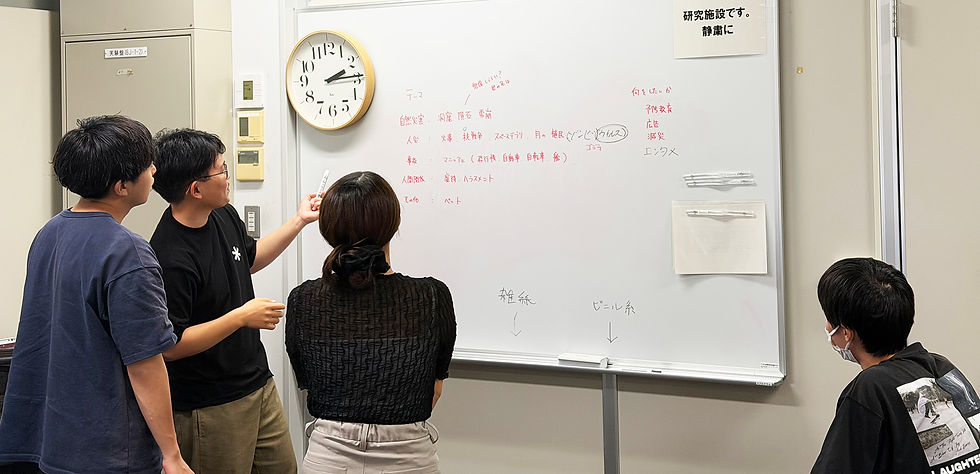
午後①(13:00–14:00)チーム編成 ― どんな空間をつくるかを話し合い、役割を決めます。
午後②(14:00–18:00)制作実習 ― Blenderなど、3DCGアプリケーションを立ち上げ、時にAIのプロンプトエンジニアリングの指導も行いながら防災メタバースの試作をつくります。
午前は「受け取る側」、午後は「つくる側」。
一日のなかで学生の立場が反転する設計になっています。 そして、2日目以降は、実際に出来上がったコンテンツを用いて、設定した課題の解決へ対処します。 調査、構想から、実際の課題解決までの手順を思考し、チームで共有が出来る形まで落とし込み、実際に制作作業を体験し、課題の解決までを行うことで、『価値』を創造する事が出来る人になるための切っ掛けを提供します。
知識を受け取る学びから、知識を空間化する学びへ。
この切り替えが、演習全体の要です。
4. チームで考える ― 一人の才能では、必ずどこかで行き詰まる
制作は個人作業ではなく、チームで進めます。ここで私たちが下敷きにしているのが、才能を三つの軸で捉える考え方です。
創造性 ―― 何を作るか、世界観を思いつく力
再現性 ―― 論理で形にし、手順化して品質を整える力
共感性 ―― 相手の気持ちを察し、伝え、人を巻き込む力
大切なのは、どれが優れているかではなく、どれも欠かせないという点です。
創造だけでは空中分解し、設計だけでは誰の心も動かさず、共感だけでは何も決まらない。三つが噛み合ったとき、はじめて「使ってみたい」と思える空間が生まれます。
学生には、監督・空間設計・モデリング・防災視点・広報といった役割を割り当てます。
自分の得意を知り、異なる強みを持つ仲間と噛み合わせる経験は、将来どんな組織で働くうえでも土台になります。
価値創造は一人の天才の仕事ではなく、さまざまな価値や才能の力の設計だと体感してもらうことが狙いです。
5. AIは「答えの自販機」ではなく「共同作業者」
午後の制作では、AIを積極的に使います。
ただし、答えを出させる道具としてだけの使用ではありません。 調査・設計・改善を共に進める協働相手として位置づけています。
操作に詰まったらAIに聞けば大抵手が止まりませんが、それ以上に重要なのは、問いを立てる訓練になることです。 よいプロンプトを書くとは、「自分は何を知りたいのか」を言葉にすること。 返ってきた答えを見て質問を練り直す往復のなかで、目的から逆算して考える習慣が育ちます。
「地震のとき危険になる家具をリスト化して」 「四人チームでの役割分担を提案して」 ―こうした問いを重ねる経験は、単なる作業を課題解決へと変えていきます。 単に生成AIを用いて時間短縮を行うだけではなく、プロンプトエンジニアリングの入口を、ここで自然に体験してもらいます。
6. 学びは「順番」に宿る ―― 土台づくりから課題発見へ
制作では、いきなり細部を作り込みません。
「土台をつくる → 危険を見つける → 改善する」という順番を必ず守ります。
まず床・壁・机・本棚で空間を立ち上げ、次にどこが危険かを調べて話し合い、そのうえで避難経路を引き、固定すべき家具を可視化する。
造形だけなら「作業」ですが、「どこが危険か」を考えさせて、はじめて「教材」になります。
この順番そのものが、思考のトレーニングです。
目の前の手作業に没頭するのではなく、常に「何のために」を問いながら進める。
演習は二回に分け、初日は空間をつくり、次回はそれを地震で「揺らして」検証し、防災教材へと仕上げます。
つくって終わりではなく、検証して人の行動を変えるところまでを一つの学びとして設計しています。
7. ゴールは「完璧なコンテンツ」ではない
初日の到達点は、美しいCG作成ではありません。 防災教材として意味のある空間の「試作品」です。
発表で学生に語ってもらうのも、技術の巧拙ではありません。
何をつくったか、どこに危険を見つけたか、なぜそう考えたか、次回どこを検証したいか。
思考の跡を言葉にすることを評価の中心に置いています。
きれいに仕上げる力より、意味を見いだし、それを他者に伝える力を問う。
ここに、この演習の価値観が表れています。
大学教育への提案として
この演習は、VRやメタバースを教える講座であると同時に、それらを「考える力を鍛えるための題材」として使う試みです。
身近な課題を自分ごととして捉え、チームで異なる強みを噛み合わせ、AIを協働相手に問いを立て、順番を守って考えながらつくる―、一連のプロセスは、分野を問わず通用する「価値を生み出す思考」の型そのものです。
社会がこれから、より必要とするのは、与えられた作業を正確にこなす人だけではありません。
課題を発見し、新しい価値を構想できる人材です。
その育成には、思考すること、知識、そして教養が不可欠であり、それらは具体的な題材と手を動かす経験のなかでこそ育ちます。
メタバースという新しい入口を借りながら、大学だからこそ育てられる「考える力」を鍛える。
この演習を、そうした学びの一つのモデルとして提案します。 EN / Title
Beyond Makers: Cultivating People Who Think and Create Value The Instructional Design Behind Okayama University's Metaverse Space Studio
On July 4, 2026, we held the first session of the "Metaverse Space Studio" at Okayama University. Students put on VR headsets to step inside a disaster environment, built a three-dimensional space of their own, and pushed their production forward by putting questions to an AI whenever they got stuck. Judged on that description alone, it might look like a skills course in the latest tools.
But what this studio truly sets out to develop is not operators who can run software. It is people who can identify the problems a society faces and generate new value in response to them.
This article sets out how the studio is designed, and what significance it is intended to hold as a university course, for those engaged in education.
1. The Aim Is Not to Produce People Who Move Their Hands
A studio dealing with VR and the metaverse is often assumed to have technical mastery of modeling as its goal. Yet the ability to produce high-fidelity CG is not, in itself, what this studio is after.
What we want to convey to students lies one step before that. Investigate what you are building something for; define the problem; construct the concept; and think the path to a solution all the way through. Production is merely the means to that end.
People who will actually work with their hands to finish content are, of course, needed. But what society calls for even more is people who can discover the problems themselves and envision value that does not yet exist. This demands the capacity to think, a broad base of knowledge, and cultivation of mind. The fundamentals of a technique can be acquired in a matter of months; the ability to decide what to ask is grown only through the discipline of thinking. This studio is designed as a place to train that thinking itself, borrowing VR production as its concrete subject matter.
2. Why "Disaster-Prevention Metaverse" as the Subject
The theme of the studio is to remake the classrooms and laboratories students use every day into spaces that can be "inspected for safety." If an earthquake strikes, which bookshelf topples, which equipment falls, which exit is blocked? Which route offers the safest evacuation?
There is a reason we deliberately chose a familiar space as the subject. The story of a distant disaster tends to end as someone else's concern; but the moment one considers the dangers of the very room one is standing in, the problem becomes, all at once, one's own. To lift disaster preparedness from something known as knowledge to an understanding deep enough to change behavior — this is the shift we most want students to experience.
Disaster prevention is also a subject with no single correct answer. Safety versus convenience, cost versus effect, safety for whom. The experience of exercising judgment while shouldering conflicting choices is, in itself, a rehearsal for the kind of thinking that creates value in society.
3. The Shape of a Day: From "Receiving" to "Making"
The first day ran from 10:00 to 18:00, structured in four broad parts.
Morning ① (10:00–10:30) — VR Experience and Introduction. First, to know in the body what it feels like to "enter a space." Students come to understand through experience that VR is not a device for viewing images, but a device for standing within them.
Morning ② (10:30–12:00) — Cases and Context. What does it mean to translate specialist knowledge into a "communicable experience"? By seeing how VR is being implemented in research, disaster prevention, and medicine, students grasp the whole arc of production.
Afternoon ① (13:00–14:00) — Team Formation. Discussing what kind of space to build, and assigning roles.
Afternoon ② (14:00–18:00) — Production Studio. Launching Blender and other 3DCG applications and, at times with guidance in the prompt engineering of AI, building a prototype of a disaster-prevention metaverse.
The morning places students on the "receiving" side; the afternoon, on the "making" side. The design deliberately reverses the student's standpoint within a single day. From the second day onward, students then take the content they have actually built and work to resolve the problem they had set. By reasoning through the sequence from investigation and conception all the way to genuine problem-solving, distilling it into a form the whole team can share, experiencing the act of production firsthand, and carrying it through to a resolution, we offer them the spark of becoming people who can create value.
From a learning that receives knowledge to a learning that gives knowledge spatial form — this switch is the linchpin of the entire studio.
4. Thinking as a Team: One Talent Alone Will Always Reach a Dead End
Production is not solitary work; it proceeds as a team. The framework we take as our foundation here is a way of understanding talent along three axes.
Creativity — the power to conceive what to make, and to originate a worldview.
Reproducibility — the power to give things form through logic, to systematize into procedures, and to secure quality.
Empathy — the power to sense how others feel, to communicate, and to draw people in.
What matters is not which of these is superior, but that not one of them can be dispensed with. Creativity alone disintegrates in mid-air; design alone moves no one's heart; empathy alone decides nothing. Only when the three mesh together does a space people actually want to try first come into being.
Students are assigned roles such as director, space designer, modeler, disaster-safety lead, and communications lead. The experience of knowing one's own strength and meshing it with teammates of different strengths becomes a foundation for working in any organization in the future. Our aim is for students to feel, in their own hands, that the creation of value is not the work of a lone genius, but the deliberate design of many kinds of value and talent.
5. AI Is Not a Vending Machine for Answers, but a Collaborator
In the afternoon production, we make active use of AI. But we do not use it merely as a device for extracting answers. We position it as a working partner that advances investigation, design, and refinement together with the student.
When you are stuck on an operation, asking the AI usually keeps your hands moving. More important than that, however, is that it becomes training in framing a question. To write a good prompt is to put into words what it is you want to know. In the back-and-forth of looking at the reply and reworking the question, the habit of reasoning backward from the objective takes root.
"List the furniture that becomes dangerous in an earthquake." "Propose a division of roles for a team of four." Repeating questions of this kind is what turns mere work into problem-solving. Rather than simply using generative AI to save time, students experience here, quite naturally, the threshold of prompt engineering.
6. Learning Lives in the Sequence: From Laying Foundations to Discovering Problems
In production, we never begin by crafting the fine details. We hold firmly to the sequence: build the foundation → find the dangers → improve.
First, raise the space with floor, walls, desks, and bookshelves; next, investigate and discuss where the dangers lie; then, trace the evacuation routes and make visible the furniture that ought to be secured. Modeling on its own is "work"; only by prompting students to consider where the danger is does it become "teaching material."
That sequence is itself a training in thinking. Rather than becoming absorbed in the manual task in front of them, students proceed while constantly asking what for. The studio is divided into two sessions: on the first day they build the space; on the next they "shake" it with an earthquake to test it, refining it into disaster-prevention teaching material. It is designed so that the learning does not end at making, but carries through to verifying and changing human behavior — all as one integrated arc.
7. The Goal Is Not "Perfect Content"
The destination of the first day is not the creation of beautiful CG. It is a prototype of a space that holds meaning as disaster-prevention teaching material.
What we ask students to speak to in their presentations is likewise not technical polish. What did you make? Where did you find danger? Why did you judge it so? What do you want to verify next time? We place at the center of assessment the act of putting the traces of one's thinking into words. Rather than the ability to finish something cleanly, we ask after the ability to find meaning and to convey it to others. It is here that the values of this studio reveal themselves.
A Proposal to University Education
This studio is a course that teaches VR and the metaverse; but it is, at the same time, an attempt to use them as subject matter for training the capacity to think. Grasping a familiar problem as one's own, meshing differing strengths as a team, framing questions with AI as a collaborator, and building while thinking in a disciplined sequence — this whole process is nothing other than a template for the "thinking that generates value," one that holds across every discipline.
What society will increasingly need is not only people who execute assigned tasks with precision. It is people who can discover problems and envision new value. Cultivating them demands the act of thinking, a base of knowledge, and cultivation of mind — and these grow only within concrete subject matter and the experience of moving one's own hands.
Borrowing the metaverse as a new point of entry, we train the "capacity to think" that a university, above all, is positioned to cultivate. We offer this studio as one model of such learning.
We also warmly welcome inquiries from universities and graduate schools outside Japan.


コメント