

陰翳録 第十三灯『太鼓の音(ね)』

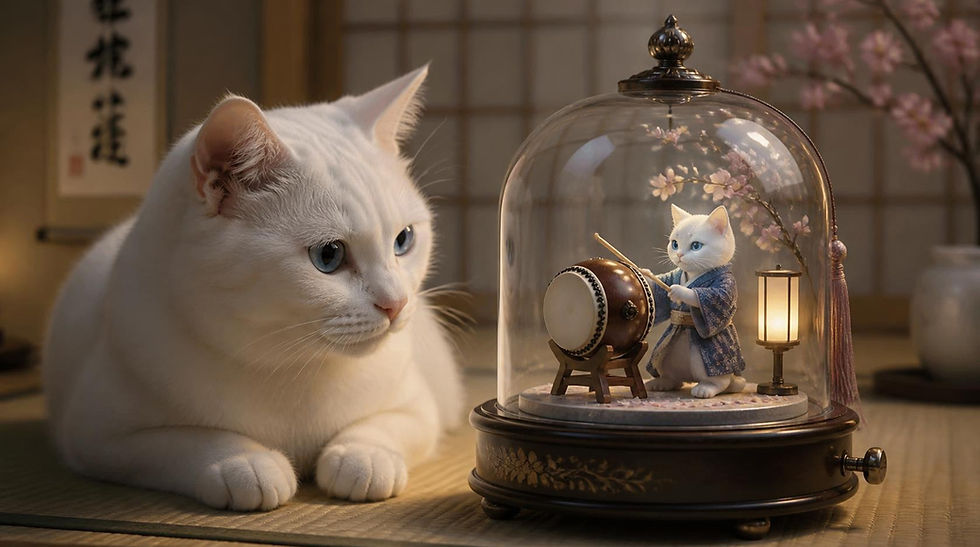
前の灯で、家のなかの、静かなお盆の話をしました。 その、どこからか聞こえてきた太鼓の音を、追いかけてみましょう。 近くの広場では、お盆の、もう一つの顔―盆踊りが、始まっています。
猫は、群れて、皆と同じ動きをする、というのが、どうにも性に合いません。
私たちは、めいめい、勝手気ままに生きるものですから。
ですから、大勢が、同じ方向を向いて、同じ手つきで、ぐるぐると回る、あの踊りは、長らく、私には、少々、奇妙に見えておりました。
いったい、何が、そんなに楽しいのか、と。
けれど、その成り立ちを調べさせて、少し、考えが変わりました。
盆踊りのおおもとは、平安の空也上人にはじまり、鎌倉の一遍上人が各地へ広めた「踊り念仏」だといわれます。
念仏を唱え、鉦や太鼓を打ち、足で大地を強く踏みしめて踊る。
その足踏みには、迷える霊を鎮め、あの世へ送る力がある、と信じられてきました。 足で踏み鎮める所作=反閇(へんばい)について、文化庁「文化遺産オンライン」の鬼剣舞の解説を参照 https://online.bunka.go.jp/heritages/detail/136547 これが、お盆の先祖供養と結びつき、迎えた魂を慰め、また送り出すための踊り―盆踊りになった、というのです。
もとは、死者のための踊りだったのです。
ここから、私は、二つの、面白いことに、気がつきました。
一つめは、この踊りの、垣根の低さです。
盆踊りの輪に入るのに、難しいことは、何ひとつ、要りません。
浴衣という、皆と揃いの衣をまとえば―これは、いわば、共通の“装い”です―あとは、輪の後ろにつき、前の人の見よう見まねで、同じ振りを、繰り返すだけ。
名乗る必要も、素性を明かす必要も、ありません。
土地によっては、顔さえ、隠してしまう。
秋田の西馬音内の盆踊りでは、踊り手が、目だけを出した黒い頭巾や、編み笠で、顔を、すっぽりと覆って踊ります。
なぜ、顔を隠すのか。―生者も、死者も、身分の上下も、みな、分からなくするため。
そうすれば、輪のなかに、亡き人がまぎれて一緒に踊っていても、誰も気づかず、皆が、気兼ねなく、一つになれるからだ、と伝えられます。
民俗学者の折口信夫は、そもそも盆とは、生きた者の魂も、死んだ者の魂も、区別なく扱う時期だった、と説きました。
折口信夫「盆踊りの話」に拠る。青空文庫の一次文献を参照 https://www.aozora.gr.jp/cards/000933/files/46316_25542.html
櫓を真ん中に、円を描いて回る、あの輪は、ただの隊形ではなく、現世と、あの世と、過去と、今とを、ひとつに繋ぐ、大きな縁(えん)の輪なのだ、というわけです。
―ここまで来て、私は、私の雇う人間たちが、日ごろ騒いでいる、あの言葉を、思い出しました。「メタバース」や、「SNS」です。
聞けば、遠く離れた者どうしが、めいめい、自分の分身をまとって、一つの場所に集い、名も、素性も伏せたまま、繋がる仕組みなのだとか。
それなら、盆踊りは、その、はるかな大先輩ではありませんか。
顔と名を消して、めいめいの「私」を脱ぎ捨て、言葉ではなく、同じ振り・同じ拍子という、身体の同期だけで、見ず知らずの者どうしが、一つの大きな輪に溶け合う―そういう仕組みは、櫓を囲んだ大昔から、とうに、あったのです。
人間たちの機械は、それを、より手軽に、より遠くまで届くように、こしらえ直しただけ。
いってみれば、あとから追いついてきた、新参者にすぎません。
概念は、いつも、人の心と体のほうに、先にあった。
もっとも、だからといって、盆踊りを、機械になぞらえて、したり顔で語るような、無粋は、しません。
櫓の提灯、太鼓の音、揃いの浴衣の波は、それ自体で、じゅうぶんに美しい。
ただ、「名も顔も消して、皆と一つになりたい」という、あの、人の胸の奥の願いだけは、遠い昔の広場も、今の光る画面の広場も、まるで同じなのだな、と。
器が変わっただけで、真ん中で人がしていることは、ほんの少しも、変わっていないのです。
そして、二つめ。
盆踊りには、ただ楽しいだけではない、もう一つの働きがあります。
岩手に、「鬼剣舞(おにけんばい)」という踊りがあります。
忿怒(ふんぬ)の面をつけた踊り手が、勇壮に舞う、念仏踊りの一種で、お盆に、亡き魂を鎮め、送るために、踊られてきました。
面白いのは、その「鬼」が、じつは、頭に角のない、仏の化身だということ。
踊りのなかで、その仏が、忿怒面の怨霊や亡魂を、足で踏み鎮め、打ち払っていくのです。
鬼剣舞に拠る。岩手県「いわての文化情報大事典」を参照 http://www.bunka.pref.iwate.jp/archive/hist91
私は、これを知って、腑に落ちたのです。
人は、日々の暮らしのなかで、口に出せぬ悲しみや、行き場のない鬱屈を、少しずつ、溜めていきます。
民俗学の柳田國男は、淡々とした日常を「ケ」、祭りや行事という非日常を「ハレ」と呼びました。
そして、その日常(ケ)を続けるうちに、人の気力は、少しずつ、すり減って、枯れていく。この「気が枯れた」状態を、「ケガレ(気枯れ)」というのだそうです。
溜まった、その澱を、ハレの祭りで、祓い、清め、また新しい力を取り戻して、日常へ帰る。「ハレ・ケ・ケガレ」の、循環です。
柳田國男『明治大正史 世相篇』、および波平恵美子『ケガレの構造』、桜井徳太郎『共同討議 ハレ・ケ・ケガレ』などの民俗学の議論による。
盆踊りとは、まさに、これだったのです。
日頃、胸の底に溜めこんだ、悲しみや、鬱屈や、行き場のない思いを、鬼という、目に見えるかたちにして、皆で、足で、踏み鎮める。
そして、送り火のように、この世の外の、遠い彼方へ、そっと、流し送る。踊り終えたころには、心の澱は、いくらか軽くなり、人は、また、明日を生きる力を取り戻して、日常へと、帰っていく。
もっとも、これも、はっきり申し上げておきます。
踊って、迷える魂を送る、といっても、本物の、あの世への門が、どこかで、開くわけでは、ありません。
開くのは、踊る人の、心のなかの境です。
ひと晩だけ、その心のなかに、もう会えぬ人や、抱えきれぬ思いを、迎え入れ、一緒に、輪を回り、そして、送り出す。踊りが終わり、面を外し、日常へ戻るとき、心のなかに開いていたその境は、そっと、閉じる。会いたい人も、重い思いも、また、記憶の奥へ、彼方へと、帰っていく。―あの世と、この世の境は、天のどこかや、地の底にあるのではなく、それを想う、人の心のなかにこそ、あるのだと、私は思います。
さて、私はといえば、やはり、輪には、加わりません。
猫は、群れず、一猫で生きるもの。
皆と同じ方向を向いて回るなど、まっぴらです。
けれど、櫓の灯りが遠くに揺れ、太鼓の音が、どん、と、夜風に乗って届く晩には、私は、屋根の上から、その、ぐるぐると回る人の輪を、眺めるのが、嫌いでは、ありません。
あの輪のどこかで、もう会えないはずの、なつかしい誰かも、こっそり踊り、踊り手たちは、めいめい、胸の澱を、そっと流している。
家の内で、亡き人を、静かに心へ迎える者がいれば、家の外で、皆と輪になって、にぎやかに送り出し、ついでに、自分の澱まで、送り流す者もいる。
同じお盆の、静と動。―なるほど、人間も、なかなか、よくできた仕組みを、持っているものです。もっとも、私は、屋根の上から、一歩も、動きませんが。
それでは、また、次の灯で。 白社長
Title
In'eiroku, Thirteenth Light: The Voice of the Drum
In the last light, I told of the quiet Obon inside the house. Let us now chase that drum, whose voice came drifting in from somewhere. In the square nearby, Obon's other face — the Bon dance — has begun.
Cats simply have no temperament for flocking together and moving in unison with everyone else. We are creatures who live, each of us, as we please. And so that dance, in which a great crowd faces the same direction, makes the same motions with their hands, and goes round and round, long looked to me a little peculiar. What on earth, I wondered, is so enjoyable about it? But having had its origins looked into, my thinking shifted somewhat.
The wellspring of the Bon dance is said to be the "dancing nenbutsu," begun by the Heian-era holy man Kūya and spread throughout the provinces by the Kamakura-era holy man Ippen. Chanting the nenbutsu, striking gongs and drums, one dances while stamping the earth strongly underfoot. That stamping was believed to hold the power to quiet wandering spirits and send them off to the other world (regarding the treading-down gesture known as henbai, see the explanation of Onikenbai in the Agency for Cultural Affairs' "Cultural Heritage Online," https://online.bunka.go.jp/heritages/detail/136547 ). This joined with the ancestral memorial rites of Obon, and became a dance for consoling the souls one has welcomed and then sending them off again — the Bon dance. Originally, it was a dance for the dead.
From here, I noticed two interesting things.
The first is how low the threshold of this dance is.
To enter the circle of a Bon dance, nothing difficult whatsoever is required. Don a yukata — the garment everyone shares, a kind of common "attire," so to speak — and after that, you simply fall in at the back of the circle and repeat the same motions, copying the person in front of you. There is no need to give your name, no need to disclose who you are. In some regions, they even conceal the face. In the Bon dance of Nishimonai in Akita, dancers cover their faces entirely with black hoods that leave only the eyes, or with woven sedge hats. Why hide the face? — So that the living, the dead, and the ranks of high and low all become indistinguishable. That way, even if the departed have slipped into the circle and are dancing along, no one notices, and everyone can become one without reserve. So it is handed down.
The folklorist Orikuchi Shinobu explained that Bon was, from the outset, a season in which the souls of the living and the souls of the dead were handled without distinction (based on Orikuchi Shinobu's "A Talk on the Bon Dance." See the primary text at Aozora Bunko, https://www.aozora.gr.jp/cards/000933/files/46316_25542.html ). That circle, drawing a ring around the scaffold-tower at its center, is not a mere formation, but a great ring of en — of binding ties — joining this world and the next, the past and the now.
— Having come this far, I recalled that word the humans in my employ are forever making a fuss about. "Metaverse," and "SNS." From what I hear, people far apart from one another each don a likeness of themselves, gather in a single place, and connect while keeping their names and identities hidden. Well then — the Bon dance is their distant senior, is it not?
To erase face and name, to shed each person's "I," and, with no words at all, through nothing but the synchrony of the body — the same motions, the same beat — to have utter strangers melt together into one great circle: such a mechanism existed long ago, already, around those scaffold-towers. The humans' machines have merely rebuilt it so that it is handier, and reaches farther. They are, so to speak, latecomers who caught up afterward. The concept was always there first, in the human heart and body.
That said, I shall not be so graceless as to liken the Bon dance to a machine and hold forth about it knowingly. The lanterns on the tower, the voice of the drum, the waves of matching yukata — these are beautiful enough entirely on their own. It is only that the wish deep in the human breast — "to erase my name and face, and become one with everyone" — is exactly the same in the square of long ago and in the glowing screen-square of today. Only the vessel has changed; what people are doing at its center has not shifted in the slightest.
And the second thing. The Bon dance has another function, beyond mere enjoyment.
In Iwate there is a dance called Onikenbai — the demon sword dance. Dancers wearing masks of wrathful visage perform it valiantly; it is a kind of nenbutsu dance, danced at Obon to quiet the souls of the dead and send them off. What is fascinating is that its "demon" is in fact an incarnation of the Buddha, without horns upon its head. Within the dance, that Buddha treads down and drives away the vengeful spirits and restless souls of the wrathful masks (based on Onikenbai. See Iwate Prefecture's "Grand Encyclopedia of Iwate Cultural Information," http://www.bunka.pref.iwate.jp/archive/hist91 ).
Learning this, something fell into place for me. In the course of daily living, people accumulate, little by little, sorrows they cannot speak aloud and gloom that has nowhere to go. The folklorist Yanagita Kunio called the plain, everyday round ke, and the extraordinary time of festivals and observances hare. And as that daily ke continues, a person's vital spirit gradually wears thin and withers. This state of "withered spirit" is what is called kegare — ke-gare, the withering of ke. The sediment that has gathered is purged and cleansed at the hare of the festival, and one recovers fresh strength and returns to daily life. The circulation of "hare, ke, kegare" (based on the folklore-studies discussions in Yanagita Kunio's Meiji Taishō-shi: Sesō-hen, Namihira Emiko's Kegare no Kōzō, and Sakurai Tokutarō's Kyōdō Tōgi: Hare, Ke, Kegare).
The Bon dance was precisely this. The sorrow, the gloom, the feelings with nowhere to go that one has stored at the bottom of the breast — these are given a visible form, that of a demon, and everyone treads them down together, underfoot. And then, like a send-off fire, they are quietly set adrift toward the far beyond, outside this world. By the time the dancing ends, the sediment of the heart has grown somewhat lighter, and people return to daily life having recovered, once again, the strength to live tomorrow.
That said, let me state this plainly as well. To dance and send off wandering souls does not mean that a genuine gate to the other world opens somewhere. What opens is the boundary within the dancer's own heart. For one night only, into that heart, one welcomes the person one can no longer meet, or the thought one cannot carry, circles the ring alongside them, and then sends them off. When the dancing ends, the mask comes off, and one returns to ordinary life, that boundary which had opened in the heart quietly closes. The person one longs for, and the heavy feeling, both go back again — into the depths of memory, into the far beyond. — The boundary between this world and the next lies not somewhere in the heavens nor at the bottom of the earth, but within the heart of the one who thinks of them. So I believe.
Now, as for me — I still do not join the circle. A cat does not flock; a cat lives as one cat. To face the same direction as everyone else and go round and round is quite out of the question.
But on nights when the tower's lanterns sway in the distance, and the voice of the drum arrives — don — riding the night wind, I do not mind gazing down from the rooftop at that ring of people, turning and turning. Somewhere in that circle, some dear soul one ought never to meet again is dancing in secret, too, and the dancers, each of them, are quietly letting the sediment of their hearts flow away. While there are those who, inside the house, quietly welcome the departed into their hearts, there are those who, outside the house, form a circle with everyone, send them off in high spirits, and — while they are at it — send their own sediment flowing away as well. The stillness and the motion of one and the same Obon. — Indeed, humans do possess a rather well-made contrivance. Though I, from up on the roof, shall not budge a single step.
Until the next light, then.
President Snowlion


コメント