

第14期を迎えて ― 伝承を未来へ渡すために

2026年8月1日、株式会社白獅子は第14期目を迎えました。
ひとえに、多くの方に支えていただいたおかげです。
—と、こう書くと定型の一文になってしまいますが、この一年を振り返るほど、これは本当に文字通りのことだったと思わされます。
監修をお引き受けくださった研究者の皆様。現場で災害体験VRを回してくださった自治体・消防・学校のご担当者。研究室で議論に付き合ってくださった大学生の皆さま。視察に足を運んでくださった方々。日頃ご支援ご指導くださっているインキュベータ、また金融機関、行政、団体の皆様。そして、社内で日々活動し続けている会社の猫さん(他社様でいうスタッフさん)。 白獅子の13年は、そのどれが欠けても成り立ちませんでした。 あらためて、心より御礼を申し上げます。
第14期の初めにあたり、今、私たちがどこに立っていて、どこへ向かおうとしているのかを書かせてください。

AIとメタバースが「噛み合った」一年
この一年、社内で最も議論したのは、AIとメタバースをどう融合させるかというテーマでした。
メタバースは、長らく「集まれる場所」として語られてきました。 けれども防災や災害医療の文脈では、場所があるだけでは足りません。 そこに人がいて、判断があって、対話が起きることが必要です。 避難所運営とは、まさにそういうものだからです。
そこで私たちは、AIを「賢い機能」としてではなく、空間の中に人格として置く方向で開発を進めてきました。
避難所オペレーション訓練の試作では、行政職員の方がVR体験者となり、人格を持つAIアバターである避難者へ対応します。 体験中の視線、移動、操作、判断のタイミング、対話、アバターの心理状態の推移を記録し、体験後にAIが多視点から評価する。 評価は正解・不正解ではなく、避難者の安全、公平・配慮、情報伝達と安心、職員の持続性、全体最適—複数の観点から行います。
避難所運営の難しさは、ある観点で最適な対応が、別の観点では最適でなくなることにあります。 その構造そのものを訓練の対象にしたい。 これがこの取り組みの出発点です。
AIがメタバースにもたらす利点は、映像を美しくすることではありません。 同じ空間を、何度でも、条件を変えて、人の判断を試せる場に変えることです。 人数分の演者を集めることも、実際の被災者に協力を求めることもできない訓練において、これは決定的な違いだと考えています。
※本項は研究開発・試作段階の取り組みであり、現在ご提供中の災害体験VRの機能とは異なります。
防災と災害医療 ― ここまでと、ここから
災害体験VRは、岡山市消防局からの一本のご相談から始まりました。 模擬家屋燃焼実験の炎の中で溶けたあの360度カメラは、今も社内に置いてあります。 溶けたカメラを見つつ、白獅子は、我々に代わり、危険な場所へと向かい、人々の生命と生活を守る人たちへ貢献したいと考えました。 あの時、溶けたカメラは、その、私たちの決意の印です。
そこから、広島県、大阪市、浜松市をはじめ全国140カ所を超える現場へ広がり、体験者は延べ13万人を超えました。 大阪・関西万博でもご覧いただきました。 この一年も、浜松市防災学習センター「はま防〜家」を訪ね、納品から数年を経てなお日々動き続けている姿を確認してきたところです。
イベントではなく、地域の日常の中に根を張っていること—これに勝る評価はありません。
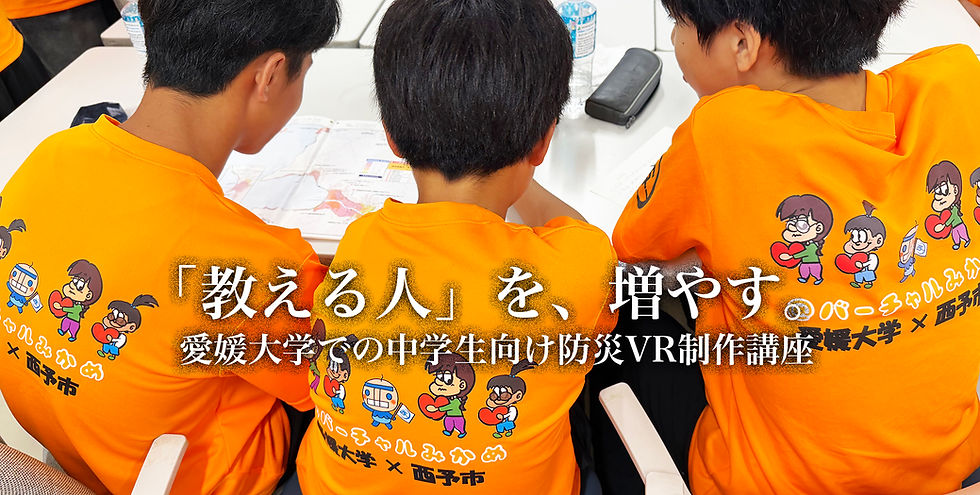
研究面では、岡山大学・岡山市消防局との火災行動研究、京都大学防災研究所との津波・高潮VRを用いた評価研究、そして東京大学生産技術研究所 目黒研究室・RC-77研究会でのHazAwareVR開発、愛媛大学防災センターとの共同研究と、それぞれ性格の異なる取り組みが並走してきました。
災害医療の領域では、岡山大学・森恵子教授との共同研究が大きく前進しました。
看護学生や市民が災害現場を疑似体験して「生き残る力」を育てるVRと、食道がん術後の患者さんが地理的・時間的な制約を越えてつながる「支え合う力」のメタバース。
学術的設計・倫理審査・医療監修は大学が担い、白獅子は体験を届ける器をつくる。
この役割分担を曖昧にしないことが、研究を速く前へ進めると実感した一年でもありました。
そして11月には、日本地震工学会大会にて、RC-77での成果を展示・発表し、論文としても投稿いたします。
現場で使われてきたものを、学術の側の検証に載せる。この往復こそが、私たちが「なんせ、科学ですから」と言い続けてきたことの実体です。
会場でお目にかかれましたら幸いです。
海外へ ― 環太平洋という地図の引き直し
災害は国境で止まりません。
森教授との共同研究は、将来的にインドネシア・フィリピンといった国々への展開を見据えています。
環太平洋防災推進拠点の構想も、同じ地図の上にあります。
地震、津波、火山、豪雨—環太平洋は、被害の記憶を共有できる圏域です。
日本で積み上げた知見をそのまま輸出するのではなく、それぞれの土地の災害史と生活様式に合わせて翻訳し直すこと。第14期は、その具体的な一歩を踏み出す期にしたいと考えています。 人が育ち、人が訪ねてくれた一年
この一年で最も嬉しかったことを一つ挙げるなら、スタッフの成長です。
クリエイター、デザイナー、エンジニア、そして契約・経理・広報を支える面々。 新聞記事の写真に写るのはいつも一部の人たちですが、実際にはその何倍もの行動が活きています。 最初は一人で始めた白獅子、以前なら私が同席していた打ち合わせに、今は会社の猫さんたちで出て、クライアントや外部パートナーと対等に議論して帰ってくる。 その報告を聞くたびに、白獅子は次の段階に入ったのだと感じます。
視察のご来訪も、インターンの受け入れも増えました。学生さんが白獅子のラボを訪れ、開発が進む現場を見て、目の色が変わる瞬間があります。 こういった姿を見られるのは経営者の役得だと思っています。
見学に来られた方から新しいご縁が生まれ、そのご縁がまた次の共同研究につながる。この一年、そういうことが本当に何度もありました。
私事ですが ― 民族学者になりたかった幼少期
最後に、少しだけ個人的な話を書かせてください。
子どもの頃、私は考古学、民俗学者になりたいと思っていました。 土の下から出てくるもの、村に伝わる話、地名に残る痕跡。 そういうものに、今でも惹かれます。
VRと3DCGの技術を用いた開発の会社の経営を行っている今、あの頃の関心から遠くへ来たのかというと、まったくそんなことはないと感じています。
日本各地には、災害が物語や伝承の形で残されています。 津波の到達点を示す石碑、水害を語り伝える民話、地名に埋め込まれた警告、社寺の縁起に紛れ込んだ被害の記録。 近代的な観測記録が始まるはるか以前から、人々は「次にこれが起きたら、こうしなさい」という知恵を、物語という器に入れて未来へ送り続けてきました。
これは、私たちがやっていることと、まったく同じ構造です。
体験を、後の世代が受け取れる形に翻訳して手渡す。 器が口承や石碑からXRに変わっただけで、目的はいっぺんも変わっていません。
だからこそ、第14期の白獅子は、過去の伝承や物語として残された災害の記録を、XRで再現し、未来へ渡していく取り組みに本格的に着手したいと考えています。 文化財や古代楽器の3D再現で培ってきた技術は、そのためのものでもありました。
千年近く前に誰かが必死に残した警告を、現代の人が「体験できる」形に復元する。
そして今度は私たちが、次の数百年へ向けて記録を残す。
学者にはなりませんでしたが、やりたかったことの本質には、案外まっすぐ近づいているのかもしれません。
第14期の白獅子として
白獅子は、VRをつくる会社ではありません。 専門家の知見と、現場の経験と、過去から届いた記憶を、人が動ける体験へ変える会社です。
知っているだけでは、いざというときに動けない。その「知っている」と「できる」のあいだにある壁を、XR・3DCG・AI・メタバースで埋めていく。第14期も、その一点に集中してまいります。
See, Change, Act! ——見て、変わり、行動する。
引き続き、ご指導ご鞭撻を賜りますよう、心よりお願い申し上げます。
株式会社白獅子 社長 春名白 代表取締役 春名義之 EN/Title Entering Our 14th Year — Carrying Handed-Down Memory Into the Future On August 1, 2026, Snowlion, Inc. entered its 14th year.
This has been possible only because so many people have supported us.
Written plainly like that, it reads as a stock phrase. But the more I look back on this past year, the more I find it is true in the most literal sense.
The researchers who took on the work of supervising our projects. The staff at municipalities, fire departments, and schools who ran our Disaster Experience VR out in the field. The university students who sat with us through discussions in the lab. Everyone who took the time to visit us. The incubator, financial institutions, government offices, and organizations who guide and support us day to day. And the company cats who keep things moving inside Snowlion — what other companies would call "staff."
Not one of those could have been missing from these thirteen years. My sincere thanks to every one of you.
As we begin our 14th year, let me set down where we stand now, and where we intend to go.
The Year AI and the Metaverse Finally Clicked Together
The question we argued about most this year was how to bring AI and the metaverse together.
The metaverse has long been described as "a place where people can gather." But in disaster preparedness and disaster medicine, a place alone is not enough. There have to be people in it, decisions being made, and conversations taking place. That, after all, is exactly what running an evacuation shelter is.
So we moved in a different direction: not treating AI as a clever feature, but placing it inside the space as a person.
In our prototype for evacuation-shelter operations training, a government employee is the one wearing the headset, responding to evacuees who are AI avatars with personalities of their own. Gaze, movement, actions, the timing of decisions, dialogue, and shifts in each avatar's emotional state are all recorded, and afterward an AI evaluates the session from multiple angles.
The evaluation is not a matter of right and wrong answers. It looks at evacuee safety, fairness and consideration, communication and reassurance, the sustainability of the staff member's own workload, and overall balance — several perspectives at once.
The real difficulty of shelter operation is that a response which is optimal from one perspective stops being optimal from another. We wanted to make that structure itself the subject of the training. That is where this work began.
What AI brings to the metaverse is not more beautiful visuals. It is the ability to turn one space into somewhere a person's judgment can be tested again and again, under changing conditions. In training where you cannot assemble enough actors, and certainly cannot ask actual disaster survivors to participate, we believe this is a decisive difference.
Note: This section describes research and prototype work, and differs from the features of the Disaster Experience VR we currently offer.
Disaster Preparedness and Disaster Medicine — How Far We've Come, and What's Next
Disaster Experience VR began with a single inquiry from the Okayama City Fire Department.
The 360-degree camera that melted in the flames during the simulated house-burn experiment is still here in our office. Looking at that camera, we resolved that Snowlion would contribute something to the people who go toward danger in our place, protecting lives and livelihoods. That melted camera is the mark of that resolve.
From there the work spread to Hiroshima Prefecture, Osaka City, Hamamatsu City, and beyond — more than 140 sites nationwide, with over 130,000 people having gone through the experience. It was also shown at Expo 2025 Osaka, Kansai.
This year, too, we visited the Hamamatsu City Disaster Prevention Learning Center, "Hamabo-ya," and saw the system still running day after day, years on from delivery. Not an event, but something that has put down roots in the everyday life of a community — there is no evaluation better than that.
On the research side, several efforts of very different character have run in parallel: fire-behavior research with Okayama University and the Okayama City Fire Department; evaluation research using tsunami and storm-surge VR with the Disaster Prevention Research Institute, Kyoto University; the development of HazAwareVR with the Meguro Laboratory of the Institute of Industrial Science, The University of Tokyo, through the RC-77 research committee; and joint research with the disaster prevention center at Ehime University.
In disaster medicine, our joint research with Professor Keiko Mori of Okayama University moved forward considerably. On one side, VR that builds "the ability to survive," letting nursing students and members of the public experience a disaster scene firsthand. On the other, a metaverse that builds "the ability to support one another," where patients recovering from esophageal cancer surgery can connect across the barriers of distance and time.
The academic design, ethics review, and medical supervision are the university's domain; Snowlion builds the vessel that delivers the experience. This was a year in which I felt keenly that keeping that division of roles clear is precisely what moves research forward faster.
And this November, at the Annual Meeting of the Japan Association for Earthquake Engineering, we will exhibit and present our results from RC-77, and submit them as a paper as well.
Taking what has been used in the field and putting it up for scrutiny on the academic side — this back-and-forth is the substance of what we mean when we keep saying, "Because it's science, after all."
We would be delighted to meet you at the venue.
Going Abroad — Redrawing the Map of the Pacific Rim
Disasters do not stop at borders.
Our joint research with Professor Mori looks ahead to expansion into countries such as Indonesia and the Philippines. Our concept for a Pacific Rim disaster resilience hub sits on the same map.
Earthquakes, tsunamis, volcanoes, torrential rain — the Pacific Rim is a region that can share the memory of damage.
Not exporting the knowledge we have built up in Japan as-is, but re-translating it to fit each place's own disaster history and way of life. We intend to make our 14th year the one in which we take a concrete first step toward that.
A Year in Which People Grew, and People Came to Visit
If I had to name the single thing that made me happiest this year, it would be the growth of our staff.
Creators, designers, engineers, and the people who handle contracts, accounting, and communications. Only some of them ever appear in a newspaper photograph, but many times that number of people are at work behind it.
Snowlion started with just me. Meetings I once had to attend myself are now handled by our company cats, who go out, hold their own in discussions with clients and outside partners, and come back. Every time I hear one of those reports, I feel that Snowlion has moved into its next stage.
Visits and internships both increased. Students come to our lab, see development actually underway, and there is a moment when the look in their eyes changes. Getting to witness that is one of the perks of running a company.
New connections have come from people who came to observe, and those connections have led to the next joint research. This year, that happened again and again.
On a Personal Note — The Child Who Wanted to Be a Folklorist
Let me close with something a little more personal.
As a child, I wanted to become an archaeologist or a folklorist. Things that come up out of the ground, the stories passed down in a village, the traces left behind in place names. Those things still draw me in today.
Now that I run a company developing with VR and 3DCG, has that early interest been left far behind? Not in the slightest, as far as I can tell.
Across Japan, disasters survive in the form of stories and oral tradition. Stone markers showing how far a tsunami reached. Folktales that pass down the memory of a flood. Warnings embedded in place names. Records of damage tucked into the founding legends of shrines and temples.
Long before modern observational records began, people were sending knowledge into the future — "if this happens again, do this" — placed inside the vessel of a story.
This is exactly the same structure as what we do.
Translate an experience into a form later generations can receive, and hand it over. The vessel has changed from oral telling and stone monuments to XR. The purpose has not shifted once.
That is why, in its 14th year, Snowlion wants to begin in earnest on the work of recreating in XR the records of disasters that survive as legend and story, and carrying them forward into the future. The techniques we have built up reconstructing cultural properties and ancient musical instruments in 3D were, in part, meant for this.
To take a warning someone left behind in desperation nearly a thousand years ago, and restore it into something a person today can actually experience. And then, in turn, for us to leave a record for the centuries ahead.
I never became a scholar. But I may have come rather more directly to the heart of what I wanted to do than I expected.
Snowlion in Its 14th Year
Snowlion is not a company that makes VR.
We are a company that turns the knowledge of experts, the experience of the field, and the memory handed down to us from the past into experiences that let people act.
Knowing is not enough to move when the moment comes. That wall between "knowing" and "being able to do" is what we fill in with XR, 3DCG, AI, and the metaverse. In our 14th year, too, we will concentrate on that single point.
See, Change, Act! — See it, change, and act.
We ask for your continued guidance and support.
Snowlion, Inc.
President,Snowlion
Representative Director,Yoshiyuki Haruna

コメント