

岡山から問う“体験のその先”——OKAYAMA防災FES出展報告
- 広報SC

- 3月17日
- 読了時間: 8分
更新日:4月15日

2026年3月14日(土)・15日(日)、コンベックス岡山で開催された「OKAYAMA防災FES in コンベックス岡山」にて、株式会社白獅子は「災害体験VR」を出展いたしました。 今回の催しは、家族で見て・聞いて・体験しながら防災を学ぶことを目的とした防災普及啓発イベントとして開催され、会場には消防、警察、自治体、赤十字、JAFなど多様な関係機関が集いました。

岡山は、古くは吉備の国として栄え、山陽道や舟運を通じて周辺地域と結ばれてきた土地です。 現在も、山陽新幹線、山陽本線、瀬戸大橋線、山陽自動車道、岡山自動車道、岡山空港などが集まる中四国の広域交通網のクロスポイントであり、人と物が行き交う要所です。 だからこそ、この地で防災を考えることは、岡山だけの課題にとどまらず、広い地域の備えを考えることにもつながります。
一方で岡山は、穏やかな気候から「災害が少ない県」と語られることもありました。
しかし、2018年の平成30年7月豪雨では県内に甚大な被害が生じ、その後も県や市は水害、南海トラフ巨大地震、津波などを想定した備えの強化を進めています。
岡山市も、南海トラフ巨大地震は「ひとごとではない」と明記し、防災マップや津波ハザードマップの整備を進めています。岡山で防災を伝える意味は、まさにこの現実の上にあります。
展示会、開催当日は、14日(土)約4,000人、15日(日)約6,000人の方が来場され、私たちの災害体験VRブースにも長蛇の列が途切れませんでした。
足を止めてくださった皆様、体験してくださった来場者の皆様に、心より御礼申し上げます。
また、このような機会をつくってくださった主催者の皆様、ご協賛各社、ご協力機関の皆様にも、深く感謝申し上げます。
会場全体が、防災を「知識」ではなく「自分ごと」として受け止めようとする熱気に包まれていたことを、強く感じました。
私たちは、災害を扱うとき、亡くなられた方々やご遺族への敬意と配慮を決して忘れてはならないと考えています。
災害に遭われた方々の痛みは、簡単に整理できるものではありません。
その感情を外から評価したり、急いで意味づけたりするべきではないと思います。
だからこそ私たちは、災害の恐ろしさを単なる刺激として消費するのではなく、「この体験を、どうすれば生き残るための想像力へつなげられるか」という出口まで責任を持って設計しなければならないと考えています。
そういった理由から、白獅子の災害体験VRは、単に恐怖を与えるためのコンテンツではありません。 体験中に「怖かった」と感じることは入口です。 しかし、そこで終わっては意味がありません。 出口は、「自分はどのタイミングで逃げるのか」「何を優先し、何を諦めるのか」「家族とどう動くのか」を、具体的に思い描けるようにすることです。 私たちが目指しているのは、恐怖の演出ではなく、生存のための想像力を立ち上げることです。
その意味で、私たちの災害体験VRには、重要な役割があります。
防災は大切だと知っている。備えた方が良いことも分かっている。それでも、日常の中では動けない。あるいは、防災そのものにまだ強い関心を持てていない。実際には、その層こそ最も大きく、地域全体の防災力を底上げするには、その方々へ届く仕組みが必要です。
私たちのVRは、すでに危機意識の高い人だけのためのものではありません。
むしろ、「分かっているのに動けない」「まだ自分ごとになっていない」最大層に対して、意識の変化 → 行動変容 → 習慣化 の流れをつくるための装置です。
これは、防災教育において非常に重要な役割だと考えています。
また、私たちの災害表現は、印象だけで作られているものではありません。火災表現については、岡山市消防局・岡山大学・白獅子による産学官共同研究「心理学×VR×消防データで“逃げ遅れゼロ”へ」という取り組みの知見を背景に持っています。
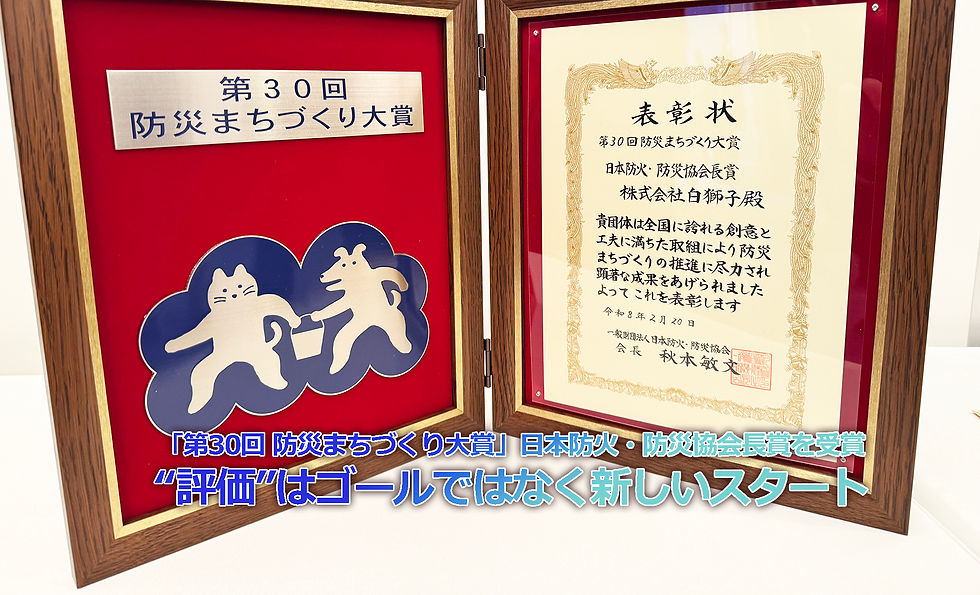
実際にこの共同研究は、防災x減災サステナブル大賞、国土強靭化計画レジリエンスアワード、第30回防災まちづくり大賞など、多くの受賞対象にもなっており、「知っているのに動けない」をどう越えるかという課題に向き合っています。
水害表現についても、京都大学防災研究所・藤見俊夫准教授との連携のもとで開発を進めています。
公開されている情報から、災害状況の3DCG動画は、洪水地図のような記述的情報よりも洪水への備えの意図を有意に高め、その効果を恐怖の高まりが媒介したこと、さらに脳画像実験では、3DCG洪水動画が洪水地図よりも、恐怖処理に関連する脳領域である扁桃体の活性化を引き起こしたことが示されています。
つまり、同じ「情報」でも、ただ見るだけではなく、体験として受け取ることで、人の心身には異なる反応が生まれ、行動に結びつく可能性が高まるということです。
これは、私たちのコンテンツの大きな強みでもあります。
災害は、知識だけでは乗り越えられません。
しかい、感情だけでもまた、十分ではありません。
必要なのは、知識と感情と行動をつなぐ設計です。
私たちはこれからも、培ってきた研究・技術・実装の知見をもとに、「怖かった」で終わらない、「どうすれば生き残れるか」を考えられる体験を社会へ届けてまいります。
改めまして、この度は、主催者の皆様、ご協賛各社、ご協力機関の皆様、ご来場くださった皆様、そして体験してくださったすべての皆様に、心より感謝申し上げます。
これからの地域防災の底上げへつなげていけるよう、引き続き取り組んでまいります。

当日のダイジェスト映像はコンベックス岡山の公式チャンネルからご覧いただけます。
EN Title
Beyond Fear, Toward Preparedness: Snowlion’s Disaster Experience VR at OKAYAMA Disaster Prevention FES On March 14 and 15, 2026, Snowlion Inc. presented its Disaster Experience VR at OKAYAMA Disaster Prevention FES in Convex Okayama, a large-scale public event dedicated to disaster awareness and preparedness.
Designed as an opportunity for families to learn through seeing, hearing, and experiencing, the event brought together a wide range of organizations, including fire and police departments, local governments, the Red Cross, and JAF. It was a place where disaster preparedness was not treated as abstract knowledge, but as something to be understood through direct engagement.
Okayama holds a unique place in western Japan. Historically, it flourished as part of the ancient Kibi region and developed through its connections to major transportation routes and waterways. Today, it remains a key transportation crossroads, linking the wider Chugoku and Shikoku regions through railways, expressways, and air access.
That is precisely why disaster preparedness in Okayama matters. It is not only a local issue. It is part of thinking about resilience across a much broader area.
Okayama has often been seen as a region with relatively few natural disasters due to its mild climate. However, the devastating heavy rains of July 2018 reminded everyone that no area is exempt from risk. Since then, both prefectural and municipal authorities have continued to strengthen preparedness for flooding, a possible Nankai Trough mega-earthquake, and tsunami scenarios.
In this context, communicating disaster preparedness in Okayama carries particular significance. It means confronting risk not as a distant possibility, but as a real and present responsibility.
The response at the event was overwhelming. Approximately 4,000 people attended on Saturday and 6,000 people on Sunday, and long lines continued throughout the event at Snowlion’s Disaster Experience VR booth.
We would like to express our deepest gratitude to everyone who stopped by, to all visitors who experienced our work, and to the organizers, sponsors, and partner organizations who made this opportunity possible.
What we felt most strongly during the event was the energy of a space where disaster preparedness was being approached not simply as information, but as something personal.
When we create disaster-related content, we believe it is essential never to lose sight of respect for those who lost their lives and for the families left behind. The pain caused by disaster is not something that can be neatly explained or easily reduced to a message.
For that reason, we do not believe disaster experiences should be consumed as mere shock, spectacle, or emotional reaction.
At Snowlion, we believe the role of disaster simulation is to move beyond fear and toward survival.
Our Disaster Experience VR is not designed simply to make people feel afraid. Feeling fear may be the starting point, but it is not the goal. The real purpose is to help people imagine, in concrete terms, what they would actually do: When would I evacuate? What should I prioritize? What must I leave behind? How would I act with my family?
What we aim to create is not fear itself, but the imagination needed to survive.
This is why our VR has an important role in disaster education.
Many people already know that preparedness matters. They know they should be ready. And yet, in everyday life, many still do not act. Others remain only weakly interested in disaster preparedness at all. In reality, this group is often the largest. If society is serious about raising its overall level of preparedness, it must find ways to reach precisely these people.
Snowlion’s VR is not only for those who are already highly aware of disaster risk.
Rather, it is designed for the largest group: those who know but do not act, and those who have not yet made preparedness personally meaningful. Its role is to create a path from awareness, to behavioral change, to habit formation.
We believe this is one of the most important functions of disaster education.
Our disaster representations are also grounded in research, not created from impression alone.
Our fire-related content draws on findings from a joint industry-academia-government research project conducted with the Okayama City Fire Department and Okayama University under the theme of using psychology, VR, and fire data to reduce delayed evacuation. This work has been recognized through multiple awards and reflects our continued effort to address one of the most difficult challenges in preparedness: how to bridge the gap between knowing and acting.
Our flood-related content is also being developed in collaboration with Associate Professor Toshio Fujimi of the Disaster Prevention Research Institute at Kyoto University.
Publicly available research has shown that 3DCG-based disaster videos can increase people’s intention to prepare for flooding more effectively than descriptive tools such as flood maps, with heightened fear acting as a mediating factor. Brain imaging studies have also indicated stronger activation of the amygdala, a brain region associated with fear processing, when participants viewed 3DCG flood simulations rather than conventional flood maps.
In other words, even when the information itself is similar, the way it is delivered matters. Information that is merely seen is different from information that is experienced. When people receive risk as an experience, it can produce a deeper psychological response and a stronger possibility of leading to action.
This is one of the defining strengths of Snowlion’s work.
Disasters cannot be overcome through knowledge alone.
But emotion alone is not enough either.
What is needed is a design that connects knowledge, emotion, and action.
Snowlion will continue to build and deliver experiences that do not end with “that was scary,” but instead help people ask a more important question: How can I survive?
Once again, we extend our sincere thanks to the organizers, sponsors, partner organizations, all visitors, and everyone who experienced our VR at OKAYAMA Disaster Prevention FES.
We will continue working to strengthen disaster preparedness at the community level by creating experiences that lead not only to awareness, but to action.


コメント